
Education as the practice of freedom
Freedom.
This word is caked in a red-white-and-blue bravado that I’ve actively distanced myself from. Other words like this have been similarly americanized—distorted into oversaturated replicas of something good and real. Words like: evangelical, patriot, and truth. Do these words give you the ick? If not these, which words do?
I’m afraid to discuss freedom. I hide behind wanting to be certain and consistent in my behavior before I open my mouth. I tell myself that’s wise and honorable. Let’s be real: I’m afraid of rejection. I’m afraid of the assumptions people will make about me if I start talking about freedom for the oppressed. What will people assume I mean based on what they think I’m saying?
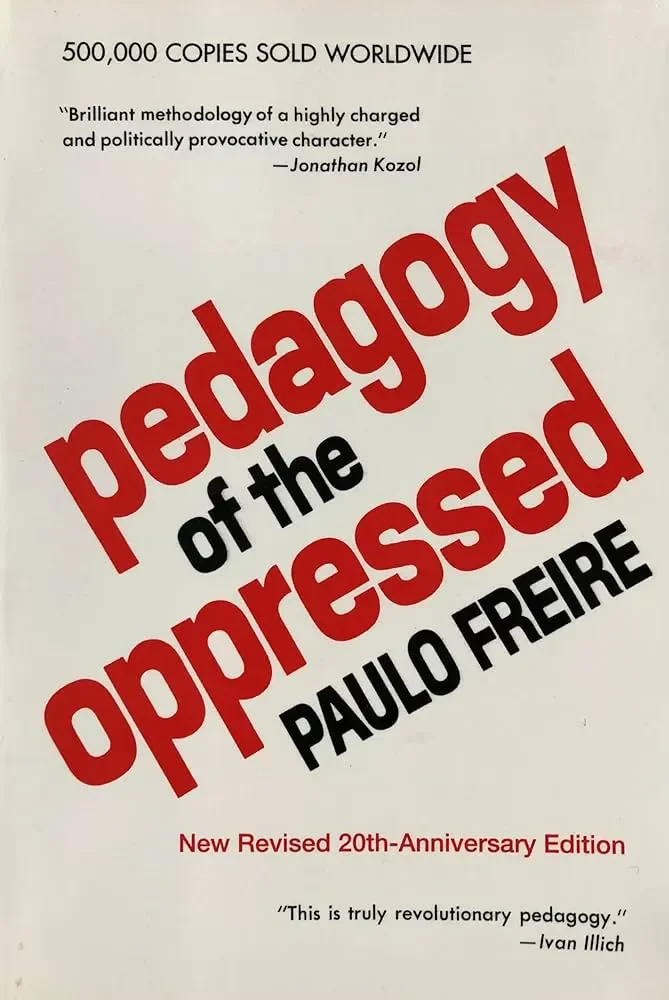
Enter Paolo Freire. He has me considering the source of my fear in a new way: I’m being alienated—or fear I will be.
“Any situation in which some individuals prevent others from engaging in the process of inquiry is one of violence. The means used are not important; to alienate human beings from their own decision-making is to change them into objects” —Paulo Freire, Pedagogy of the Oppressed, p.58
In this section Freire refers specifically to the oppressed. And let’s be clear, as an educated, cis-gendered, middle-class, large, white, American, male, I am decidedly NOT oppressed. If we accept this as true and also agree with Freire’s binary idea: oppressor or oppressed, then I am clearly among the oppressors, as there is no third option. I am either actively working to liberate humans from oppression, or I am actively working to perpetuate oppression. Invited by Freire into a praxis—which he defines as the combination of reflection and action, ongoing—I’m stuck agreeing with his assertion.
I am the oppressor.
Praxis demands action: what am I going to do about it?
Who or what then is acting to alienate me from my own decision-making if I’m among the ruling elite? Well it’s my fellow oppressors, of course! You see, if I too-closely examine the benefits we oppressors are awarded for existing and begin to question the fairness and justice of not working to liberate the oppressed, then I am a threat. As a member of the ruling class, my fellow elites would use violence against me (if the subtler and more genteel methods of distraction and misdirection fail) to keep me from this very process I’m exploring with you now. I have been alienated from praxis. As such, much of my life’s work has only served to perpetuate the systems that keep me in power, and to keep others down. It is important to note that my ignorance of how deep this goes doesn’t let me off the hook.
If Freire is right, if it’s really an either/or: either oppressor or oppressed, how can I be a loving and good man while I remain on the side of the oppressor? What am I to do?
I’m taking a risk thinking these thoughts.
I’m taking a risk sharing them with the world. I’m afraid as I look both inward, and as I look outward. What risks am I taking if I join the fight for liberation? What do I stand to lose if I invest this privilege in creating educational opportunities for all? How will my whole life change (and the lives of my loved ones) if I go all-in on believing that the purpose of education is to make us all more free and work to that end?
I’m taking a risk not thinking these thoughts & asking these questions.
By attempting to avoid this discomfort, I’m showing you that my comfort (resulting from the power, influence, and standing afforded me by the color of my skin, my zip code, and my family) is worth more to me than what I could get for others by giving away this comfort for their sake. I have amassed power. Will I give it away? (Side note: if you’ve made it this far and still don’t believe that white privilege is real: consider the fact that I actually do get to make this choice and that violence against me is theoretical at this point. The fact that I get to make the choice is itself evidence of the privilege. The oppressed don’t write exploratory and theoretical blog posts about the possibility of violence. They live it against their will and cannot step outside it in thought or action—it permeates. No, fellow white person, you and I were dealt a killer hand.)
“If what characterizes the oppressed is their subordination to the consciousness of the master, as Hegel affirms, true solidarity with the oppressed means fighting at their side to transform the objective reality which has made them, ‘beings for another.’ The oppressor is solidary with the oppressed only when he stops regarding the oppressed as an abstract category and sees them as persons who have been unjustly dealt with, deprived of their voice, cheated in the sale of their labor—when he stops making pious, sentimental, and individualistic gestures and risks and act of love… to affirm that men and women are persons and as person should be free, and yet to do nothing tangible to make this affirmation a reality is a farce.” - p.24
He’s talking to me, y’all. He’s asking me:, Will I continue to view the oppressed as a category of objects, or as persons treated unjustly? Or, will I just write blog posts and make pious gestures? Am I willing to be a joke?
This isn’t the start of this journey of discovery for me. I am a man of faith who counts my privilege as a gift, unearned and undeserved. Our Creator gives each of us gifts, designed to be used to bless others. In blessing us, he shows his goodness and sets us moving toward others— His blessings are never to be hoarded, never just for us. We are like Abram, “[blessed] so that you will be a blessing.” I believe this is God’s plan, and I consistently work to align my life with this belief. I see Freire encouraging me to go deeper into this journey.
Will I risk an act of love?
Read on Substack.
